

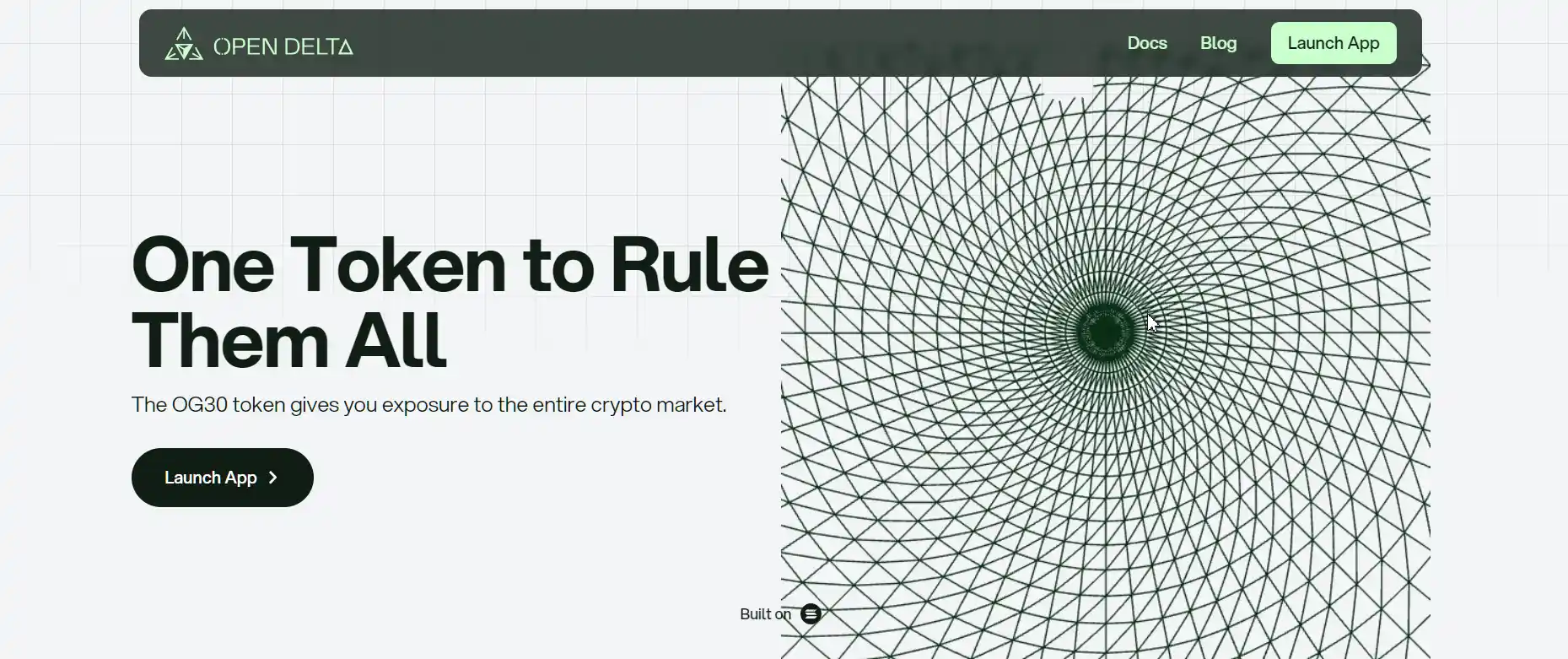
OpenDelta — is a blockchain protocol designed for creating tokenized indices and next-generation structured products. The project combines the principles of traditional financial indices with the possibilities of Web3, offering users a single tokenized access point to a diversified basket of digital assets. The main goal of OpenDelta is to make crypto investing transparent, composable, and accessible while maintaining an institutional level of security. The protocol integrates custody mechanisms, proof-of-reserves verification, and automatic rebalancing of assets, creating a bridge between DeFi and regulated financial structures. Due to its versatility, OpenDelta opens the way for a new generation of financial instruments where users retain full control over their assets while enjoying institutional-grade trust and transparency.
- Purpose and Market Role of OpenDelta
- Architecture and Operating Principles
- OpenDelta Products and GMCI Partnership
- Infrastructure, Security, and Transparency
- Ecosystem, Use Cases, and Key Risks
Purpose and Market Role of OpenDelta
OpenDelta serves as a technological and regulatory foundation for building on-chain indices and tokenized portfolios. In a world where investors face hundreds of assets and networks, the project solves the problem of aggregated exposure — one index token represents a share in a complete basket. This approach simplifies portfolio management and increases transparency. Unlike classic ETFs, OpenDelta uses smart contracts to calculate Net Asset Value (NAV) and perform automated rebalancing, improving accuracy and trust. Moreover, OpenDelta lowers the entry barrier to digital investing, allowing users to gain market exposure without deep technical expertise. It becomes a bridge between traditional index funds and the DeFi ecosystem.
Architecture and Operating Principles
OpenDelta is built on a hybrid architecture that combines on-chain logic with off-chain infrastructure. This design ensures the security of smart contracts while maintaining reliable custody solutions. Below are the core features of the protocol:
- Multi-chain compatibility. Indices can include assets from multiple networks without bridges or wrappers.
- Institutional-grade custody. Assets are stored in secure, audited structures with verified reserves.
- Independent methodology. Asset composition and weights are professionally defined and publicly available.
- Yield activation. Underlying assets participate in staking or lending to generate additional returns.
- Composability within DeFi. Index tokens integrate seamlessly with liquidity pools and yield protocols.
This architecture makes OpenDelta a universal platform for building next-generation index products. Each token reflects the real NAV of its basket and can be freely used across DeFi ecosystems. Thanks to its flexible multi-chain model, the protocol integrates with major networks such as Ethereum, Solana, and BNB Chain, providing broad scalability and interoperability.
OpenDelta Products and GMCI Partnership
The flagship product of OpenDelta is OG30 — an index tracking the performance of the top 30 cryptocurrencies. It was developed in collaboration with analytics provider GMCI, ensuring methodological integrity and regular rebalancing. OG30 operates on the Solana blockchain, offering high speed and low transaction fees. The table below shows the key parameters of the product:
| Parameter | Value | Description |
|---|---|---|
| Token Name | OG30 (OpenDelta GMCI 30) | Index of the top 30 crypto assets by market capitalization |
| Network | Solana | High-speed network with minimal fees |
| Methodology | GMCI | Independent provider and index auditor |
| Rebalancing | Automated | Periodic update of the basket composition |
| Yield | Activated | Includes staking of underlying assets |
The OG30 index demonstrates how an on-chain alternative to traditional index funds can function. Its structure combines broad market exposure with built-in yield mechanics, making it appealing for both long-term investors and active DeFi participants. Future plans include launching thematic indices — for example, sector-specific, AI-related, or Layer-2 ecosystems.
Infrastructure, Security, and Transparency
OpenDelta emphasizes institutional-level security by implementing three main trust mechanisms. First, it uses an off-exchange settlement model that allows asset transfers outside centralized exchanges, minimizing counterparty risk. Second, it employs a proof-of-reserves system — public verification proving that each index token is backed by real assets in custody accounts. Third, it applies a bankruptcy-remote architecture that isolates investor funds from operator assets. These elements create a transparent and resilient structure that aligns with regulatory standards. Additionally, OpenDelta implements real-time reserve monitoring and smart-contract audits, reinforcing trust among users and partners.
Ecosystem, Use Cases, and Key Risks
OpenDelta builds an ecosystem that includes a web application, wallet integration, and DeFi partnerships. Users can acquire index tokens, provide liquidity, or use them in yield protocols. Airdrop campaigns and educational initiatives foster engagement and awareness of the platform.
However, using the protocol involves several risks:
- Volatility of underlying assets directly affects token value.
- Liquidity may be limited during early stages of adoption.
- Premiums or discounts to NAV can appear due to market imbalance.
- Regulatory interpretation of index tokens varies by jurisdiction.
To mitigate these risks, investors should review the basket composition, rebalancing rules, and liquidity sources. In the future, OpenDelta plans to expand into a multi-chain ecosystem and introduce dynamic indices that adapt to market trends. This evolution positions the project as a leading player in the emerging on-chain investment landscape.